

Pain underneath your ribs can be difficult to understand.
It may appear suddenly, become intense for a period of time or spread towards your back or right shoulder. You may also feel sick or experience vomiting.
For some people, these symptoms can be linked to gallstones.
Gallstones are common, and many people have them without experiencing symptoms. Problems are more likely when a stone interferes with the normal movement of bile or causes inflammation around the gallbladder.
When gallstone disease is suspected, an ultrasound scan is one of the main first-line investigations. NICE recommends liver function blood tests and ultrasound when gallstones are suspected.
This guide explains what gallstones are, the symptoms they may cause, possible complications and when a gallbladder ultrasound may help provide more information.
If you are experiencing recurring, non-emergency symptoms, you can explore VitalScan’s private ultrasound scans.
What Are Gallstones?
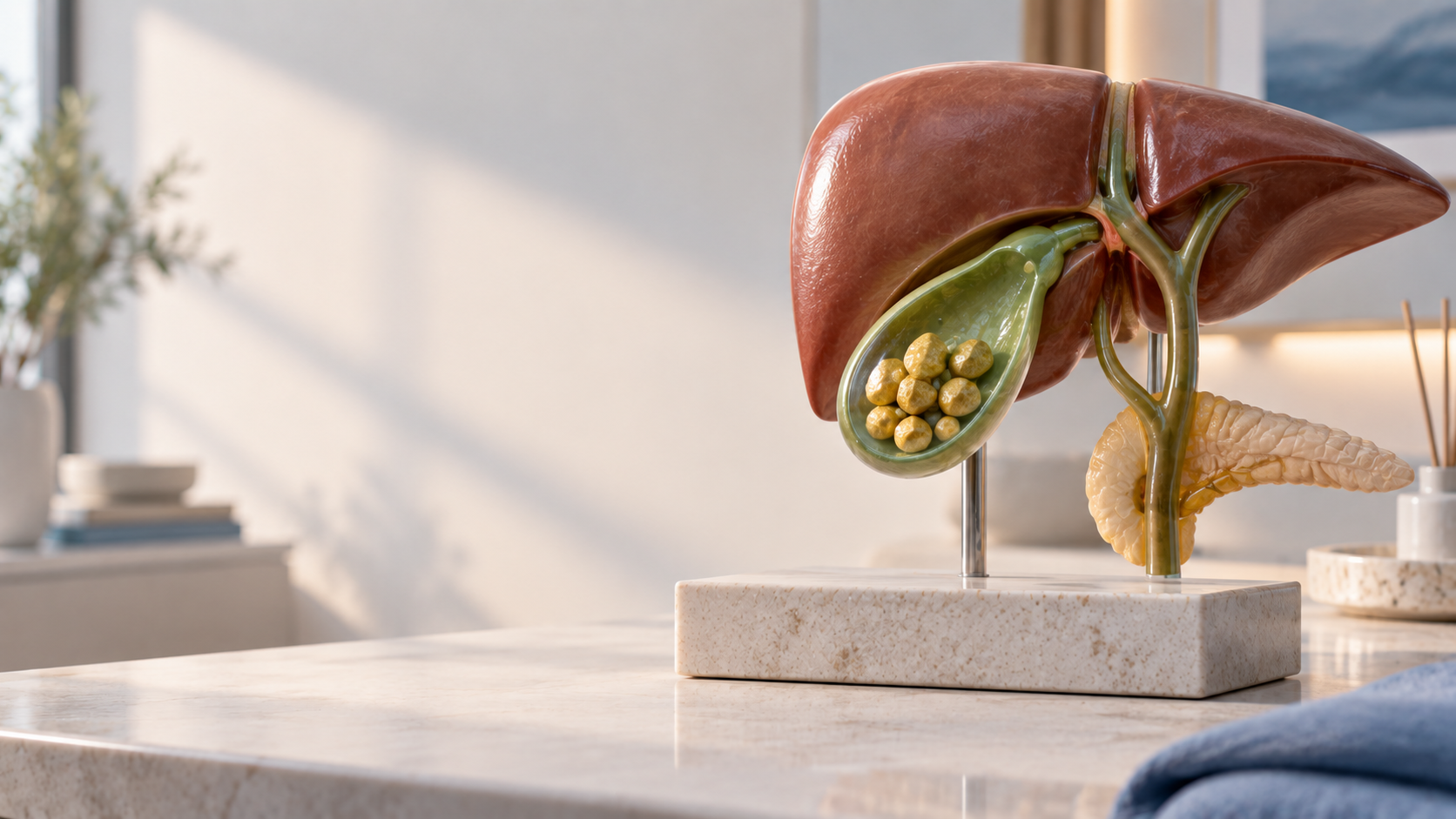
Gallstones are hardened deposits that form inside the gallbladder.
The gallbladder is a small organ underneath the liver. It stores bile, a fluid produced by the liver that helps your body digest fats.
Gallstones can vary considerably in size and number. Some people develop a single stone, while others may have several.
Many people never know they have them.
Gallstones may sometimes be discovered during imaging performed for another reason and never cause any problems.
Symptoms become more likely when a stone obstructs the outlet of the gallbladder, moves into a bile duct or contributes to inflammation.
The important question is therefore not simply whether gallstones are present, but whether they are causing symptoms or complications.
What Are the Symptoms of Gallstones?
Many people with gallstones experience no symptoms.
When symptoms do develop, pain in the upper abdomen is one of the most common complaints.
Possible gallstone symptoms include:
- Pain beneath the ribs on the right-hand side
- Pain across the upper-middle abdomen
- Severe or persistent abdominal pain
- Feeling sick
- Vomiting
- Pain spreading towards the back
- Pain around the right shoulder
- Recurring episodes of similar pain
Gallstone-related pain can become severe and remain relatively constant rather than feeling like a brief stomach cramp.
The NHS describes gallstone pain as potentially lasting longer than 30 minutes and sometimes continuing for several hours.
However, these symptoms are not unique to gallstones.
Upper abdominal pain can also come from the stomach, liver, pancreas, muscles and other nearby structures.
Symptoms alone cannot confirm whether gallstones are present.
Where Is Gallstone Pain Usually Located?
The typical gallstone pain location is underneath the ribs on the right-hand side or across the upper-middle abdomen.
The discomfort may also travel towards:
- The upper back
- The right shoulder
- The area around the right shoulder blade
This explains why some people experiencing gallstones and back pain may not initially realise that the discomfort could be linked to an abdominal organ.
Pain predominantly on the left side is less typical of gallstones and may have many other causes.
The location and pattern of pain can provide useful clinical information, but neither can confirm its cause without appropriate assessment.
What Is Biliary Colic?
Biliary colic is the term used for pain that can occur when a gallstone temporarily obstructs the cystic duct or the outlet of the gallbladder.
The pain may begin suddenly and become intense.
It is usually felt in the upper-right or upper-middle abdomen and may continue for 30 minutes or several hours.
If the obstruction clears, the pain may settle. This is why someone can experience a significant episode of pain and later feel relatively normal again.
If similar episodes repeatedly return, it is worth seeking medical assessment rather than treating each episode as unexplained stomach discomfort.
What Causes Gallstones?
Gallstones form when substances within bile begin to develop into solid deposits.
There is not always one clear cause of gallstones in an individual person.
Factors associated with a higher likelihood of developing gallstones include:
- Increasing age
- Being female
- Obesity
- Rapid weight loss
- Pregnancy
- Diabetes
- Crohn’s disease and some other digestive conditions
- Family history
Having one or more risk factors does not mean you will necessarily develop gallstones.
Gallstones can also occur without an obvious risk factor.
Are Gallstones More Common in Women?
Women have a higher likelihood of developing gallstones than men, and pregnancy is also associated with an increased risk.
However, gallstone symptoms in women are generally similar to those experienced by men.
These may include upper abdominal pain, nausea, vomiting and pain spreading towards the back or right shoulder.
Risk factors provide useful context, but they cannot determine whether gallstones are actually present.
What Happens If a Gallstone Blocks the Bile Duct?
Gallstones do not always remain inside the gallbladder.
A stone can sometimes move into the common bile duct, which carries bile towards the intestine.
A blocked bile duct may cause symptoms such as:
- Upper abdominal pain
- Yellowing of the skin or eyes
- Dark urine
- Pale stools
- Itching
- Feeling generally unwell
Gallstones in the bile duct can require further investigation and treatment.
If ultrasound does not identify a common bile duct stone but other findings continue to suggest an obstruction, further imaging such as magnetic resonance cholangiopancreatography, or MRCP, may sometimes be recommended.
Jaundice, particularly when accompanied by abdominal pain or feeling unwell, requires prompt medical assessment rather than waiting for a routine private scan.
What Is Cholecystitis?
Cholecystitis means inflammation of the gallbladder.
Acute cholecystitis commonly develops when a gallstone blocks the cystic duct, preventing bile from leaving the gallbladder normally.
Symptoms can include:
- Persistent upper-right abdominal pain
- Tenderness underneath the right ribs
- Fever
- Nausea
- Vomiting
- Feeling generally unwell
Gallstones and cholecystitis are therefore not the same thing.
You can have gallstones without having gallbladder inflammation, and many people with gallstones experience no symptoms.
Acute cholecystitis requires medical assessment and should not be managed by waiting for a routine ultrasound appointment.
Can Gallstones Cause Pancreatitis?
Gallstones can sometimes contribute to acute pancreatitis.
This can happen when a gallstone interferes with drainage around the pancreas.
Symptoms can include sudden, severe upper abdominal pain that may spread towards the back, often alongside vomiting or feeling significantly unwell.
Acute pancreatitis requires urgent medical assessment.
If your pain is severe or rapidly worsening, do not wait for a routine private ultrasound.
How Are Gallstones Diagnosed?
There is no single symptom that confirms gallstones.
Assessment may involve:
- Your symptoms and their pattern
- Your medical history
- Physical examination
- Liver function blood tests
- Ultrasound
- Further imaging where appropriate
NICE recommends liver function tests and ultrasound as first-line investigations when gallstone disease is suspected.
These investigations provide different types of information.
Liver function blood tests may show changes that can occur when bile flow is obstructed or when the liver and biliary system are affected.
An ultrasound provides real-time images of the physical structure of the gallbladder and surrounding area.
Considering these findings together can help provide a clearer clinical picture.
Can a Blood Test Detect Gallstones?
A blood test cannot directly show a gallstone.
However, liver function tests may identify changes associated with disruption to normal bile flow.
For example, bilirubin and certain liver enzymes may become abnormal when the biliary system is affected.
Blood-test results still need to be interpreted alongside your symptoms and other investigations.
If liver function needs investigating alongside imaging, you can learn more about VitalScan’s Liver Health Blood Test.
Can an Ultrasound Detect Gallstones?
Yes.
Ultrasound is one of the main first-line imaging investigations used when gallstones are suspected.
A gall bladder ultrasound scan uses high-frequency sound waves to create real-time images of the gallbladder and surrounding structures.
It does not use ionising radiation.
During the examination, ultrasound may help identify:
- Gallstones inside the gallbladder
- Changes in the gallbladder wall
- Findings associated with inflammation
- Enlargement or changes involving the bile ducts
- Relevant changes in nearby structures
Ultrasound provides useful structural information, but scan findings still need to be considered alongside symptoms, blood tests and other clinical information.
What Does the Gall Bladder Look Like on Ultrasound?
When assessing the gall bladder on ultrasound, the clinician is looking at more than whether a stone is present.
A normal gallbladder typically appears as a fluid-filled structure underneath the liver.
The examination allows the clinician to assess its shape and appearance and look for findings such as gallstones or changes involving the gallbladder wall.
The bile ducts may also be assessed where appropriate.
An individual ultrasound image should not be interpreted by itself.
The complete examination and written report are needed to determine whether a finding may be significant.
What Can Gall Bladder Ultrasound Images Show?
Gall bladder ultrasound images provide real-time structural information about the gallbladder and surrounding area.
Depending on the reason for your examination, they may help show:
Gallstones
Gallstones inside the gallbladder can often be visualised using ultrasound.
Gallbladder Wall Changes
Changes in the appearance or thickness of the gallbladder wall may sometimes occur with inflammation.
Bile-Duct Changes
Ultrasound may identify enlargement or other changes affecting the bile ducts.
Further investigation may sometimes be recommended depending on your symptoms, blood-test results and ultrasound findings.
Surrounding Structures
Other relevant structures within the upper abdomen may also be assessed where appropriate.
An ultrasound cannot identify every possible cause of abdominal pain. This is why the findings need to be considered within the wider clinical picture.
Can a Gall Bladder Ultrasound Detect Cancer?
People searching for gall bladder cancer ultrasound may wonder whether the same examination used to investigate gallstones can identify cancer.
Ultrasound may sometimes identify an abnormality involving the gallbladder that requires further investigation.
However, an ultrasound cannot confirm gallbladder cancer on its own.
If there is a concerning finding, further investigations such as CT, MRI, endoscopic ultrasound (EUS) or, in some circumstances, biopsy may be recommended.
A routine private gallbladder ultrasound should therefore not be considered a stand-alone cancer screening test.
If there is a specific clinical concern about cancer, following the appropriate medical referral and diagnostic pathway is important.
What If an Ultrasound Does Not Show Gallstones?
An ultrasound does not always provide the complete explanation for your symptoms.
If no gallstones are identified, this may mean that:
- Gallstones are not causing your symptoms
- Another structure within the abdomen needs consideration
- Blood-test findings require further assessment
- The bile ducts need additional imaging
- A different investigation may be more appropriate
For example, NICE recommends considering MRCP when common bile duct stones remain suspected despite ultrasound, particularly where the bile duct is enlarged or liver function test results are abnormal.
A normal gallbladder ultrasound therefore does not mean that recurring or unexplained symptoms should simply be ignored.
Your next step depends on the scan findings, symptoms and wider clinical picture.
What Happens During a Gallbladder Ultrasound?
A gallbladder ultrasound is performed externally across your upper abdomen.
You will normally lie on an examination couch while a small amount of ultrasound gel is applied to your skin.
A handheld probe is then moved across the upper-right part of your abdomen to obtain images of the gallbladder and surrounding structures.
You may be asked to:
- Change position
- Take a deeper breath
- Hold your breath for a few seconds
These small adjustments can help the clinician obtain clearer views.
The examination does not use radiation and is generally painless, although you may feel some pressure from the probe if the area is already tender.
You can learn more about the process on VitalScan’s private ultrasound scan service page.
Gall Bladder Ultrasound Prep: Do You Need to Fast?
Your gall bladder ultrasound prep may include fasting before the appointment.
For some abdominal ultrasound examinations, fasting can help the gallbladder remain distended and make it easier to obtain useful images.
Preparation requirements depend on the exact examination you are having.
Follow the instructions provided when your appointment is arranged rather than deciding how long to fast based on general information online.
For more information, read VitalScan’s guide on how to prepare for an ultrasound scan.
What Happens If the Ultrasound Finds Gallstones?
Finding gallstones does not automatically mean treatment will be necessary.
Gallstones found in an otherwise normal gallbladder that have never caused symptoms often do not require treatment.
If the findings appear to fit with recurring pain or if there are signs of complications, the report may need further clinical review.
What happens next can depend on:
- Your symptoms
- How frequently episodes occur
- Where the stones are located
- Whether inflammation is present
- Whether the bile ducts are affected
- Your wider medical history
The ultrasound report provides important structural information, but treatment decisions are not made from the scan alone.
How Are Gallstones Treated?
Gallstones treatment depends on whether the stones are causing symptoms or complications.
If gallstones are not causing problems, treatment may not be necessary.
When gallstones repeatedly cause significant pain, inflammation or other complications, removal of the gallbladder may be recommended.
This operation is called a cholecystectomy and is commonly performed using keyhole surgery.
Gallstones that have moved into the common bile duct may require a different approach, such as an endoscopic procedure called ERCP.
Treatment decisions take into account the location of the stones, symptoms, complications and wider clinical information rather than simply the number or size of gallstones.
When Should Gallstone Symptoms Be Treated as Urgent?
A private gallbladder ultrasound is designed to investigate appropriate non-emergency symptoms.
It is not a replacement for urgent medical assessment.
If abdominal pain lasts longer than 30 minutes, seek urgent advice from your GP or NHS 111.
Call 999 or go to A&E if you experience:
- Sudden, severe abdominal pain
- Severe pain that spreads towards your back with vomiting
- A very high temperature or significant shivering
- Yellowing of your skin or the whites of your eyes
- Severe or rapidly worsening symptoms
- Feeling acutely or seriously unwell
These symptoms can occur with complications such as acute cholecystitis, bile-duct obstruction or acute pancreatitis.
If you are unsure how urgently you need medical attention, contact NHS 111.
Private Gallbladder Ultrasound in Milton Keynes
Recurring pain beneath your right ribs can be frustrating when you do not know what is causing it.
A private gallbladder ultrasound cannot explain every type of abdominal pain. However, when the gallbladder is the clinical concern, ultrasound can provide useful structural information.
VitalScan provides private ultrasound examinations in Milton Keynes, including gallbladder imaging.
The scan can assess the gallbladder for gallstones and other structural changes without using ionising radiation.
You will receive a written report that can be shared with your GP or another healthcare professional if further assessment is required.
Concerned About Gallstones or Recurring Pain Beneath Your Right Ribs?
You do not need to work out the cause yourself.
If your symptoms are recurring and are not an emergency, a gallbladder ultrasound may provide more information about whether gallstones or another structural change could be contributing.
No GP referral required. Same-day and next-day appointments available in Milton Keynes. Our clinical team reviews every request to ensure the most appropriate scan is selected for your needs.